
The ExoMars programme 2016-2022
The ExoMars programme comprises two missions: one consisting of the Trace Gas Orbiter plus an Entry, Descent and landing demonstrator Module (EDM), known as Schiaparelli, launched on 14 March 2016, and the other, featuring a rover, with a launch date of 2022. Both missions are carried out in cooperation with Roscosmos.
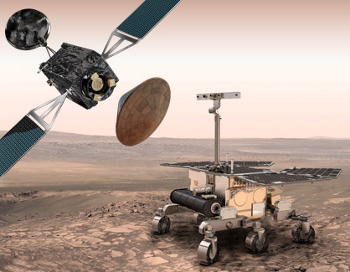 |
| Elements of the ExoMars programme 2016-2022. Credit: ESA |
The ExoMars programme will demonstrate a number of essential flight and in-situ enabling technologies that are necessary for future exploration missions, such as an international Mars Sample Return mission. These include:
- Entry, descent and landing (EDL) of a payload on the surface of Mars;
- Surface mobility with a rover;
- Access to the subsurface to acquire samples; and
- Sample acquisition, preparation, distribution and analysis.
At the same time a number of important scientific investigations will be carried out, for example:
- Search for signs of past and present life on Mars;
- Investigate how the water and geochemical environment varies; and
- Investigate Martian atmospheric trace gases and their sources.
The 2016 mission is composed of the Trace Gas Orbiter (TGO) and an Entry, descent and landing Demonstrator Module (EDM), known as Schiaparelli. TGO carries scientific instruments to detect and study atmospheric trace gases, such as methane. Schiaparelli contained sensors to evaluate the lander’s performance as it descended, and additional sensors that would study the environment at the landing site.
The 2022 mission includes a European rover, Rosalind Franklin, that will carry a drill and a suite of instruments dedicated to exobiology and geochemistry research, and a Russian surface platform, Kazachok.
Roscosmos provided a Proton launcher for the 2016 mission and will also provide one for the 2022 mission.