
ExoMars Trace Gas Orbiter and Schiaparelli Mission (2016)
The first mission of the ExoMars programme consists of the Trace Gas Orbiter plus an Entry, descent and landing Demonstrator Module, known as Schiaparelli. The main objectives of this mission are to search for evidence of methane and other trace atmospheric gases that could be signatures of active biological or geological processes and to test key technologies in preparation for ESA's contribution to subsequent missions to Mars.
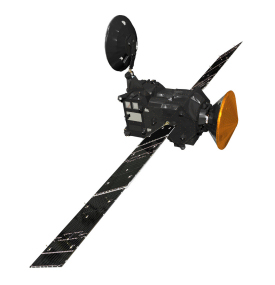 |
| ExoMars 2016: Trace Gas Orbiter and Schiaparelli. Credit: ESA/ATG medialab |
The Orbiter and Schiaparelli were launched together on 14 March 2016 on a Proton rocket and flew to Mars in a composite configuration. By taking advantage of the positioning of Earth and Mars the cruise phase could be limited to about 7 months, with the pair arriving at Mars in October.
Three days before reaching the atmosphere of Mars, on 16 October, Schiaparelli was ejected from the Orbiter towards the Red Planet. Schiaparelli coasted towards its destination, entered the Martian atmosphere at 21 000 km/h, and decelerated using aerobraking and a parachute. It was planned to then brake with the aid of a thruster system before landing on the surface of the planet, but an anomaly in the measurement and navigation system meant that the parachute and the backshell were prematurely released, followed by a brief firing of the braking thrusters and finally activation of the on-ground systems as if Schiaparelli had already landed. In reality, the vehicle was still at an altitude of around 3.7 km.
From its coasting to Mars until shortly before it reached the surface, Schiaparelli communicated with the Trace Gas Orbiter or with Mars Express.
On 19 October, the Trace Gas Orbiter was inserted into an elliptical orbit around Mars. Later, in January 2017, the orbiter performed a number of manoeuvres to shift its angle of travel with respect to the equator to almost 74° from the 7° of its October arrival. This 74° orbit will provide optimum coverage of the surface for the science instruments, while still offering good visibility for relaying data from current and future landers. In mid-March 2017, the aerobraking phase began – this eventually brought the orbiter into a circular,
Trace Gas Orbiter - Searching for signature gases in the Martian atmosphere
The Trace Gas Orbiter (TGO) spacecraft was designed by ESA, while Roscosmos provided the launch vehicle, a Proton rocket. A scientific payload with instruments from Russia and Europe is accommodated on the TGO to achieve its scientific objectives. The TGO is performing detailed, remote observations of the Martian atmosphere, searching for evidence of gases of possible biological importance, such as methane and its degradation products. The instruments on the orbiter are carrying out a variety of measurements to investigate the location and nature of sources that produce these gases. The nominal scientific mission started in April 2018 and will run for almost two years. During November 2016 and March 2017, there were two opportunities to perform some science measurements, primarily for the purposes of calibrating the science instruments. The Trace Gas Orbiter will also be used to relay data for the 2022 rover mission of the ExoMars programme.
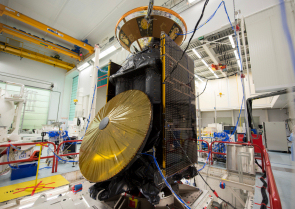 |
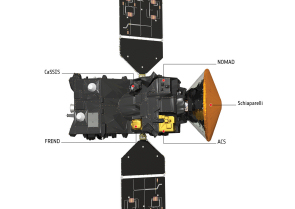 |
| ExoMars Trace Gas Orbiter and Schiaparelli during vibration testing. Credit: ESA–S. Corvaja, 2015 | ExoMars 2016: Trace Gas Orbiter and Schiaparelli. Credit: ESA/ATG medialab |
Schiaparelli: an entry, descent and landing demonstrator module
Testing critical technology for future missions
Schiaparelli, the ExoMars Entry, descent and landing Demonstrator Module (EDM) was designed to provide Europe with the technology for landing on the surface of Mars with a controlled landing orientation and touchdown velocity. The design of Schiaparelli maximised the use of technologies already in development within the ExoMars programme. These technologies included: special material for thermal protection, a parachute system, a radar Doppler altimeter system, and a final braking system controlled by liquid propulsion.
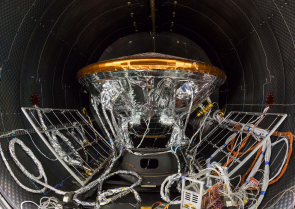 |
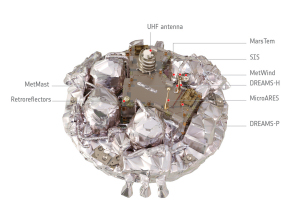 |
| Schiaparelli prepares for thermal tests. Credit: ESA – B. Bethge |
Schiaparelli - without heat shield and back cover. Credit: ESA/ATG medialab |
Schiaparelli was expected to survive on the surface of Mars for a short time by using the excess energy capacity of its batteries. The science possibilities of Schiaparelli were known to be limited by the absence of long-term power and the fixed amount of space and resources that could be accommodated within the module; however, a set of scientific sensors were included to perform limited, but useful, surface science.
|
ExoMars 2016 Mission Phases Overview |
|
| Launch | 14 March 2016 |
| Schiaparelli – Trace Gas Orbiter separation | 16 October 2016 |
| Trace Gas Orbiter insertion into Mars orbit | 19 October 2016 |
| Schiaparelli enters Martian atmosphere to land on Mars | 19 October 2016 |
| Trace Gas Orbiter changes inclination to science orbit (74°) | January 2017 |
| Apocentre reduction manoeuvres (from the initial 4-sol orbit to a 1-sol orbit) | January 2017 |
| Aerobraking phase (Trace Gas Orbiter lowers its altitude to 400 km circular orbit) | March 2017 - March 2018 |
| Superior solar conjunction (critical operations are paused while the Sun is between Earth and Mars) | 11 July - 11 August 2017 |
| Trace Gas Orbiter starts science operations | April 2018 |
| Trace Gas Orbiter starts data relay operations to support NASA landers on Mars | April 2018 |
Keeping in touch far from home
After launch and throughout the cruise phase, the spacecraft unit made up of the Trace Gas Orbiter and Schiaparelli was operated by ESA through the space communications network of ESA's European Space Operations Centre (ESOC).
After separation, the orbiter monitored the UHF transmission from Schiaparelli from its coasting to Mars until shortly before it reached the surface. Furthermore, ground-based communication arrays also tracked the UHF signal during the entry, descent and landing phases.
ESA will be in full control of the orbiter during all phases of its mission, including insertion into Mars orbit, orbit control, aerobraking, science operations and Mars communications operations.


