ExoMars Trace Gas Orbiter (TGO)
Searching for signature gases in the Martian atmosphere
The 2016 ExoMars Trace Gas Orbiter is the first in a series of Mars missions to be undertaken jointly by the two space agencies, ESA and Roscosmos. A key goal of this mission is to gain a better understanding of methane and other atmospheric gases that are present in small concentrations (less than 1% of the atmosphere) but nevertheless could be evidence for possible biological or geological activity.
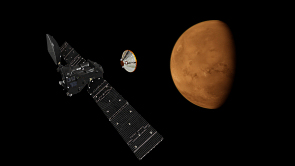 |
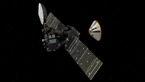
| Schiaparelli separating from the Trace Gas Orbiter. Credit: ESA/ATG medialab |
Investigations with observatories in space and on Earth have demonstrated the presence of small amounts of methane in the Martian atmosphere that has been shown to vary with location and time. Since methane is short-lived on geological time scales, its presence implies the existence of an active, current source of methane. It is not clear, yet, whether the nature of that source is biological or chemical. Organisms on Earth release methane as they digest nutrients. However, other purely geological processes, such as the oxidation of certain minerals, also release methane.
The Trace Gas Orbiter carries a scientific payload capable of addressing this scientific question, namely the detection and characterisation of trace gases in the Martian atmosphere. From its approximately 400-km-altitude science orbit, the instruments onboard the Trace Gas Orbiter are deployed to detect a wide range of atmospheric trace gases (such as methane, water vapour, nitrogen oxides, acetylene), with an improved accuracy of three orders of magnitude compared to previous measurements.
The Trace Gas Orbiter will monitor seasonal changes in the atmosphere’s composition and temperature in order to create and refine detailed atmospheric models. Its instruments will also map the subsurface hydrogen to a depth of a metre, with improved spatial resolution compared with previous measurements. This could reveal deposits of water-ice hidden just below the surface, which, along with locations identified as sources of the trace gases, could influence the choice of landing sites of future missions.
Communicating on Mars
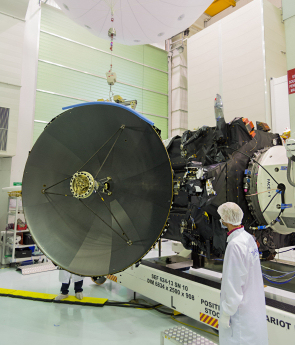 |
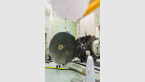
| Deployment test of the high-gain antenna. Credit: ESA - B. Bethge |
The Trace Gas Orbiter carried the Entry, Descent and landing demonstrator Module (EDM), known as Schiaparelli, on the journey from Earth towards Mars and, as it approached the planet, deployed it for entering the Martian atmosphere on its way to land on the surface of the planet. After deployment, the Orbiter monitored the UHF transmission from Schiaparelli from its coasting to Mars until its landing on the Red Planet. It also facilitated the real-time transmission to Earth of the most important data measured by Schiaparelli.
Scientific investigations will take top priority until the second mission in the ExoMars programme begins, with the arrival of the ExoMars rover, Rosalind Franklin, in 2023. At that stage the Orbiter will become a valuable Mars telecommunications asset, providing communication services to the Rover operating on the surface of Mars. The Orbiter will act as a data relay centre for sending commands to the rover and downloading data to Earth through the ESA space communications network.
|
The ExoMars Trace Gas Orbiter at a glance |
During its operational lifetime the ExoMars Trace Gas Orbiter will perform three key roles:
|
The ExoMars Trace Gas Orbiter Design
The Trace Gas Orbiter spacecraft, designed by ESA, builds on the heritage accumulated from earlier ExoMars mission scenarios. The main characteristics of the Orbiter are determined by the functions that it will perform and the launch vehicle, a Proton launcher, provided by Roscosmos.
|
Main technical characteristics of the ExoMars Trace Gas Orbiter |
|
| Spacecraft | 3.2 m × 2m × 2m with solar wings spanning 17.5 m tip-to-tip providing approximately 2000 W of power |
| Launch mass | 4332 kg (including 113.8 kg of science payload and 577 kg Schiaparelli) |
| Propulsion | Bipropellant, with a 424 N main engine for Mars orbit insertion and major manoeuvres |
| Power | In addition to power generated by the solar wings, 2 lithium-ion batteries are used to cover eclipses, with ~ 5100 Wh total capacity |
| Communication | 65 W X-band system with 2.2-m-diameter high-gain antenna and 3 low-gain antennas for communication with Earth; Electra UHF band transceivers (provided by NASA) with a single helix antenna for communication with surface rovers and landers |
| Science instrument package | Atmospheric Chemistry Suite (ACS); Colour and Stereo Surface Imaging System (CaSSIS); Fine Resolution Epithermal Neutron Detector (FREND); Nadir and Occultation for Mars Discovery (NOMAD) |