Schiaparelli: the ExoMars Entry, Descent and Landing Demonstrator Module
Schiaparelli, the European Perspective
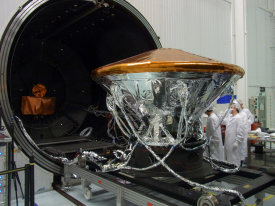 |
| Schiaparelli prepares for thermal tests. Credit: ESA – B. Bethge |
One of the core scientific goals of any mission to Mars is the search for evidence of life. The best approach is to investigate the surface where the evidence may lie.
The key element for accessing the surface of Mars and one of the greatest challenges in space exploration is the successful execution of the entry, descent and landing sequence.
This is one of the reasons why since the late 1960s there have been so many missions attempting to land on the surface of Mars, some being successful, many others ill-fated.
Schiaparelli - an entry, descent and landing demonstrator module - is a technology demonstration vehicle carried by the ExoMars Trace Gas Orbiter (TGO). Schiaparelli and TGO were launched on 14 March 2016 on a Proton rocket from the Baikonur cosmodrome in Kazakhstan. Schiaparelli will demonstrate the capability of ESA and European industry to perform a controlled landing on the surface of Mars. The preparation for this mission enhances Europe’s expertise and enables the testing of key technologies which could be used in subsequent missions to Mars.
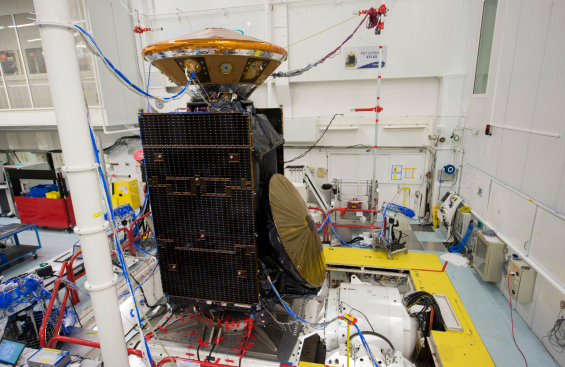 |
| The ExoMars Trace Gas Orbiter and Schiaparelli during vibration testing. Credit: ESA–S. Corvaja, 2015 |
Although designed to demonstrate entry, descent and landing technologies, Schiaparelli also offers limited, but useful, science capabilities. It will deliver a science package that will operate on the surface of Mars for a short duration after landing, planned to last approximately 2-4 sols (Martian days).
Arriving at Mars
Schiaparelli has started its journey to Mars attached to the Trace Gas Orbiter. They were launched on a Proton rocket on 14 March 2016 and will arrive approximately 7 months later at Mars.
Coast
- Three days before reaching the atmosphere of Mars, on 16 October, Schiaparelli separated from the Orbiter.
- The module is now coasting to Mars during which phase it will remain in hibernation mode in order to reduce its power consumption.
- Schiaparelli will be activated a few hours before entering the atmosphere of Mars, at an altitude of 122.5 km and a speed of approximately 21 000 km/h.
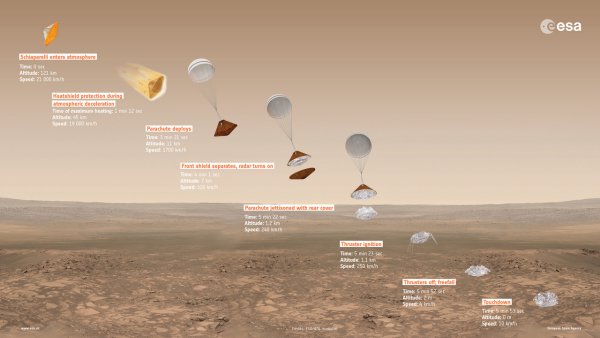 |
| Schiaparelli descent sequence. Credit: ESA/ATG medialab |
Entry
- An aerodynamic heatshield will protect Schiaparelli from the severe heat flux and deceleration, so that at an altitude of about 11 km, when the parachure is deployed, it will be travelling at around 1650 km/h.
Descent
- The module will first release the front heatshield and then the rear heatshield will also be jettisoned.
- Schiaparelli will turn on its Doppler radar altimeter and velocimeter to locate its position with respect to the Martian surface.
Landing
- The liquid propulsion system will be activated to reduce the speed to less than 7 km/h when it is 2m above the ground. At that moment the engines will the switched off and the lander will drop to the ground.
- As Schiaparelli lands, the final shock will be cushioned by a crushable structure built into module.
- The primary landing site has been identified: it is a plain known as Meridiani Planum. This area interests scientists because it contains an ancient layer of hematite, an iron oxide that, on Earth, almost always forms in an environment containing liquid water.
A communication link between Schiaparelli and the Trace Gas Orbiter will facilitate the real-time transmission of the most important data measured by the module. The complete set of data acquired will be transmitted to the Orbiter within 8 sols after the landing (a solar day on Mars, or sol, is 24 hours and 37 minutes).
|
Descent and landing at a glance |
| Three days before reaching Mars, on 16 October, Schiaparelli separated from the Trace Gas Orbiter and is now coasting towards the planet in hibernation mode, to reduce its power consumption. |
| Schiaparelli will be activated a few hours before entering the atmosphere of Mars at an altitude of 122.5 km and a speed of 21 000 km per hour. |
| An aerodynamic heatshield will slow the lander down such that at an altitude of about 11 km, when the parachute is deployed, it will be travelling at around 1650 km per hour. |
| Schiaparelli will release its front heatshield at an altitude of about 7 km and turn on its radar altimeter, which can measure the distance to the ground and its velocity relative to the surface. This information is used to activate and command the liquid propulsion system once the rear heatshield and parachute have been jettisoned 1.3 km above the surface. |
| At this point, Schiaparelli will still be travelling at nearly 270 km per hour, but the engines will slow it to less than 7 km per hour by the time it is 2 m above the surface. |
| At that moment, the engines will be switched off and Schiaparelli will free-fall to the ground, where the final impact, at just under 11 km per hour, will be cushioned by a crushable structure on the base of the lander. |
| Schiaparelli will arrive at Mars during the global dust storm season, which means that it may encounter a highly dust-loaded atmosphere. |
| The heat shield surface temperature during entry reaches approximately 1500°C. |
| The landing is controlled but not guided, and the module has no obstacle avoidance capability |
| Schiaparelli will target a landing site on the plain known as Meridiani Planum |
| Schiaparelli will be designed to be capable of landing on a terrain with rocks as high as 40 cm and slopes as steep as 12.5°. |
The ExoMars Schiaparelli Design
Schiaparelli builds on a heritage of designs that have been evaluated and tested by ESA during earlier ExoMars studies. The module accommodates a series of sensors that will monitor the behaviour of all key technologies during the mission. These technologies include a special material for thermal protection, a parachute system, a radar Doppler altimeter system, and a braking system controlled by liquid propulsion. The data will be sent back to Earth for post-flight reconstruction in support of future European missions to Mars.
The main characteristics of Schiaparelli are provided in the table below:
|
Main technical characteristics of Schiaparelli – the ExoMars Entry, Descent and Landing Demonstrator Module |
|
| Diameter Height |
2.4 m with heatshield, 1.65 m without heatshield 1.8 m high |
| Mass | 577 kg (wet) |
| Norcoat Liège | |
| Structure | Aluminium sandwich with Carbon Fiber Reinforced Polymer skins |
| Parachute | Disk-Gap-Band canopy, 12 m diameter |
| Propulsion | 3 clusters of 3 hydrazine engines (400 N each), operated in pulse-modulation |
| Power | Primary batteries |
| Communications | UHF link with the ExoMars Orbiter (with 2 antennas) |
The design activities are performed by European industry, led by Thales Alenia Space – Italy under the close supervision of ESA.
Schiaparelli science and engineering sensors
Because Schiaparelli is primarily demonstrating technologies needed for landing, it does not have a long scientific mission lifetime: it is intended to survive on the surface for just a few days by using the excess energy capacity of its batteries. However, a set of engineering and scientific sensors will analyse the local environment during descent and after landing.
Schiaparelli carries a small science payload, called DREAMS (Dust Characterisation, Risk Assessment, and Environment Analyser on the Martian Surface), to study the environment. DREAMS consists of a suite of sensors to measure the local wind speed and direction (MetWind), humidity (DREAMS-H), pressure (DREAMS-P), atmospheric temperature close to the surface (MarsTem), the transparency of the atmosphere (Solar Irradiance Sensor, SIS), and atmospheric electric fields (Atmospheric Radiation and Electricity Sensor; MicroARES) at Mars. The payload will operate on the surface of Mars for 2–8 sols.
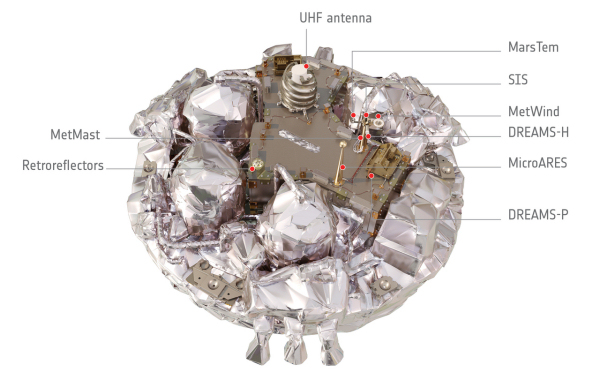 |
| Schiaparelli - without heat shield and back cover. Credit: ESA/ATG medialab |
In addition, there is an investigation known as AMELIA, for entry and descent science data collection using the spacecraft engineering sensors.
A separate instrumentation package, COMARS+, will monitor the heat flux on the back cover of Schiaparelli as it passes through the atmosphere.
A compact array of laser retroreflectors, called INRRI, is attached to the zenith-facing surface of Schiaparelli. This can be used as a target for Mars orbiters to laser-locate the module.
Read more about Schiaparelli's science studies here.